“Trump’s fossil fuel orders are a death sentence for my generation.”
Eva Lighthiser, Youth Plaintiff
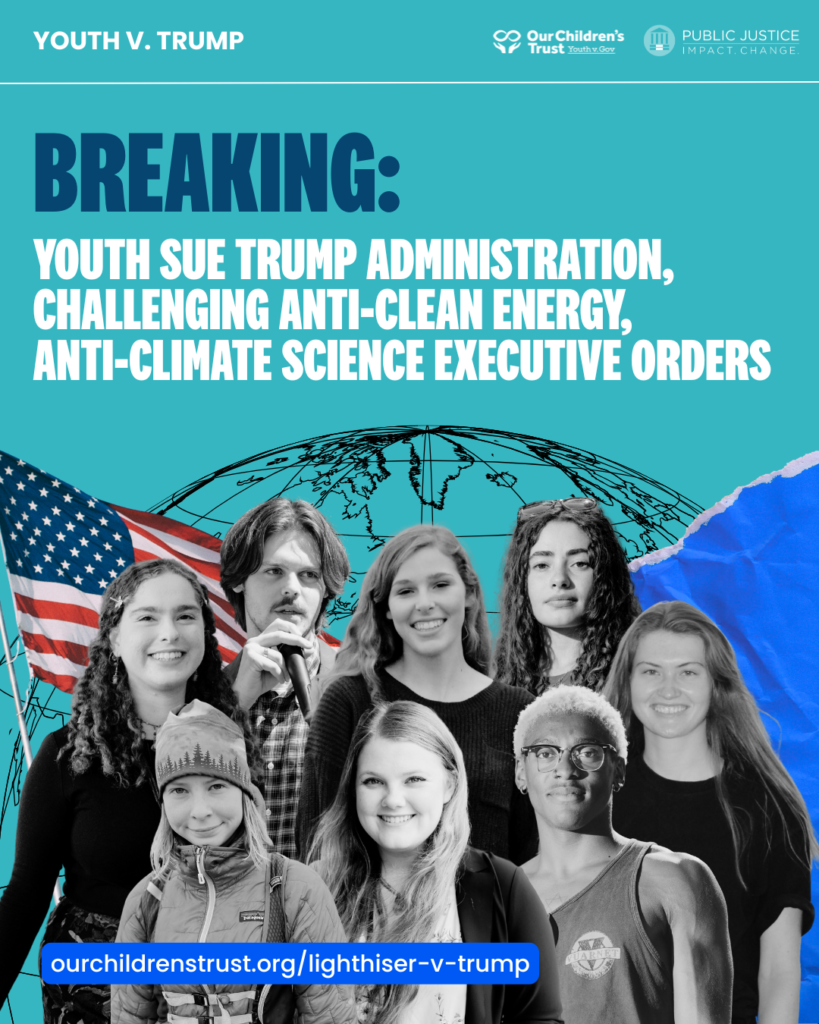
I’ve often said that our global climate change crisis is the greatest challenge that today’s youth generations will ever face, and how we deal with it will define our time here on Earth. Unfortunately, since re-taking office early this year, America’s new President and his Administration have knowingly escalated our climate crisis by irresponsibly supporting a reckless increase in fossil fuel production, suppressing climate science (and scientific research in general), and blocking productive solutions to the problem in alarming, shortsighted ways that deeply damage our environment, citizens, and people around the world.
With Trump’s evolving environmental travesty in mind, I am pleased to share that young people all over our great country are fighting back and am proud to announce that last week (May 29, 2025) I joined 21 brave, young Americans in suing U.S. President Donald Trump and the Trump Administration in federal court in hopes of stopping his assault on our environment and citizens. Our lawsuit targets not only the President but various applicable agencies and departments within his Administration including the Executive Office of the President, Office of Management and Budget, Environmental Protection Agency, Department of Energy, Department of Interior, Department of Transportation, National Aeronautics and Space Administration, Department of Commerce, National Oceanic and Atmospheric Administration, National Science Foundation, and National Institute of Health.
Our new case, Lighthiser v. Trump, is what’s called a constitutional rights lawsuit designed to challenge the Trump Administration’s stated desire to “unleash fossil fuels” through a disturbing series of Executive Orders that accelerate fossil fuel expansion while blocking wind and solar energy, storage, efficiency, and electric vehicles, intensifing our climate emergency and suppressing critical climate science. My fellow plaintiffs and I are making two constitutional claims based on (1) violations of our rights to life and liberty under the Fifth Amendment and (2) executive overreach, which in legal terms is considered “ultra vires,” meaning the president has exceeded the legal limits of his power.
Our lawsuit primarily focuses on three of President Trump’s recent Executive Orders, including:
1. Executive Order 14154 “Unleashing American Energy“: The President’s Executive Order directs the federal government to “unleash fossil fuels” and block renewable energy efforts, including renewable energy storage and efficiency measures, as well as electric vehicles. It also directs his Administration to suppress science, remove it from government websites, and block the study, research, and dissemination of climate-oriented science and its solutions, amongst other nefarious steps.
The attack on our climate and environment over the first four months of the Trump presidency has been nothing short of savage. By one account, the Trump Administration has taken 140 actions to reduce or eliminate environmental rules so as to increase the use of fossil fuels since Inauguration Day.
Over the course of 24 hours in March of this year, for example, the Trump administration’s Environmental Protection Agency issued 31 actions designed to reduce pollution regulations on cars, trucks, and power plants, while also announcing that it would reevaluate its stance on whether fossil fuel emissions endanger public health. The President’s new EPA Administrator celebrated that day’s work by announcing that he was “driving a dagger into the heart of the climate religion,” and called it “the most consequential day of deregulation in American history.” Comments such as these from the person supposedly charged with protecting our environment and public health surely mark one of America’s saddest days, shocking people around the world.
2. Executive Order 14156 “Declaring a National Energy Emergency“: On his first day in office earlier this year, President Trump declared a national energy emergency designed to dramatically loosen a variety of existing laws and regulations that otherwise limit his administration’s ability to increase the production and use of fossil fuels.
Facts and the truth matter. And the truth is that America is facing a dire climate emergency, but is NOT suffering from a national energy emergency. Consider the following:
A) The United States produces more energy than it consumes. Year over year, America has a surplus in energy production.
B) The United States produces more oil than any nation in the world, and that has been the case for many years.
C) The United States produces more natural gas than any nation in the world, and that has also been the case for several years. America produces twice as much natural gas as Russia, the world’s second-largest producer.
D) The United States is the world’s largest exporter of gasoline, the world’s largest exporter of natural gas, and the fourth-largest exporter of coal.
3. Executive Order 14261 “Reinvigorating America’s Beautiful Clean Coal Industry“: This Executive Order intends to effectively increase coal production and use here in the United States.
President Trump has long been fixated on reviving the American coal industry to its past prominence, despite the fact that the country (and much of the world beyond) has been actively transitioning away from burning coal as an energy source for decades.
Two decades ago, coal accounted for approximately 50% of America’s energy; yet, according to the U.S. Energy Information Administration, it now produces just 16.2% of our energy. Natural gas has significantly displaced coal and now accounts for 43.1% of our energy, while renewable energy sources, such as hydro, solar, and wind, continue to grow rapidly and currently account for 21.4% of America’s energy.
Even the coal industry largely knows it is a dying business. Existing American coal plants are antiquated relics that have operated, on average, for 53 years, yet the industry has not built a single new coal plant (thankfully) since 2013. In February 1985, the coal industry employed 173,000 people, according to the U.S. Bureau of Labor Statistics. However, as of March 2025, that figure has declined to just 41,200 people.
“Having young people rise up at a time when democracy is threatened and when there’s retaliation against so many people in this country for standing up against the administration, that is success. It’s about having the bravery to bring claims in the court, of not being afraid to use their rights.”
Julia Olson, Lead Lawyer for Lighthiser v. Trump & Founder of Our Children’s Trust
My friends and I believe that each of the President’s Executive Orders are unconstitutional and violate our fundamental rights to life and liberty, including our rights to health and safety and our access to state public trust resources, which are protected by the 5th Amendment of the U.S. Constitution. Federal governmental actions that unleash fossil fuels and debilitate the Environmental Protection Agency from performing the job it was created to do, that terminate the National Climate Assessment, and that cut or defund scientific research are (to again use a term from my law school education) “ultra vires,” meaning beyond the President’s constitutional and statutory power and, thus, are not legal.
With this in mind, rather than allow our nation to regress towards its polluting past or face “an environmental death sentence,” as Eva mentioned, our lawsuit will ask the court to declare each of these executive orders unconstitutional and halt the various actions already being taken by governmental agencies to implement these orders.
It goes without saying that suing a sitting President and your federal government is no small thing. It’s also incredibly sad that my young friends and I feel forced to fight this battle, to fight those misguided, morally bankrupt adults who would rather place their polluted politics and antiquated ideals ahead of our environment, sustainable solutions, and the well-being of future generations. Alas, that is very much our reality in 2025.
The good news, and it is excellent news indeed, is that my young friends and I are devoted and determined to defeat this President and his Administration.
No matter how powerful the opposition or how daunting the path, we believe – as every generation must – that justice will prevail. Because it has to, the stakes are too high.
This is our moment to fight, not out of choice, but necessity.
For what is right.
For what is legal.
For what is just.
We fight because we must. And we will not stop.
To learn more about our new landmark constitutional lawsuit, please visit www.ourchildrenstrust.org/lighthiser-v-trump or consider the following recent news articles:
The New York Times
The Guardian
Bloomberg Law
The Hill
Sierra Magazine
Inside Climate News

