Category Archives: #BeInconvenient

COP27: Sharm el-Sheikh Day

My first trip to the Middle East has been a long one, but I finally arrived to Sharm el-Sheikh yesterday and could not be more excited, nor proud, to participate. Leaving Miami on Friday night I first traveled for nearly nine hours to London and then it was off to Cairo, Egypt’s capital, on a five-hour fight. Sunday morning I awoke early and flew from Cairo into Sharm el-Sheikh, an Egyptian city located on the southern tip of the Sinai Peninsula on the Red Sea. All in all, the trip took about 35 hours from Miami including layovers, but I’ve arrived in Sharm el-Sheikh, Egypt (which means “Bay of the Sheikh” in Egyptian and is also known as the “City of Peace” given the many peace conferences held here over the decades) and today, Monday, I have been fully immersed in COP27.

And speaking of firsts, this is the very first ever COP that’s taking place in the Middle East. Given this region’s impact on fossil fuel production, having a COP here (or, for that matter, having next year’s return to the Middle East by being in the UAE) is a very important step in my view to transitioning our energy systems from fossils to sustainable solutions.

IMG_7843

This year’s event will be held at the International Convention Center (SHICC), which is one of the largest conference centers in the Middle East and Africa. And having a large site is important given the scale of COP as the world comes together to discuss our climate crisis.

IMG_7877

This year’s conference will include:

  • Over 2,000 speakers
  • More than 35,000 participants including what are called Representatives of Parties to the Convention and Observer States, members of the media, Representatives of various organizations and members of the public.
  • 300 climate-oriented topics
  • 150,000 square meters of meeting space

My day yesterday was centered on traveling from Cairo to “Sharm,” as the locals call this city, checking into my hotel, and then the Conference, obtaining my official identification (I’m here as what’s called an Observer, in this case via my affiliation with the University of Miami where I attend graduate school) and visiting the SHICC where the convention is being held.

Given the seven-hour time difference between Sharm and Miami I am writing this post on Monday morning local time. Allow me to just end by saying to my youngest readers that if a kid from Miami like myself can have an impact on a topic she’s passionate about that takes her around the world, then so can you. I will be thinking about you and our mutual future a lot this week and will be hoping that as many of you as possible will find a way to be at next year’s COP28 meeting in the United Arab Emirates to voice your concerns with the world like I plan to do here in Egypt this week.

COP27: Egypt, Here I Come!

I will never forget that Sunday afternoon nearly six years ago when I was applying to college and my parents tried to talk me into applying to a school other than the University of Miami. It’s not that they don’t love UM, after all they like my grandfather before them are proud graduates, but they did their best to suggest I consider another school whose name will not be mentioned as my first, early decision choice. As I listened to their last ditch pitch I looked up from my computer and said with all of the respect for their perspectives I could muster “sorry, it’s too late,” as I simultaneously pressed SEND and thus applied Early Decision. That decision, and the acceptance and brilliant education that followed has confirmed time and time again that the University of Miami, was the perfect choice for me. As we say around here, it’s great to be a Miami Hurricane and with today’s post I once again can share news that supports that sentiment more than I will be able to ever fully explain or write.

I’ve not been able to post as much as I’d like this semester because I am in the midst of my second year of law school and have just stared the first year of my Ph.D. work in the dual degree grad program I am ever so honored to be in here at UM’s Abess Center for Ecosystem Science and Policy. And, speaking of honored, I am pleased to share that I’ve been selected by the University of Miami School of Law to attend the United Nations Conference of the Parties 27 (COP27) and that this coming Friday will be off to Sharm El-Sheikh, Egypt.

cop27-01

I’ve closely followed the annual COP meetings as well as the United Nations’ important climate-related work for nearly a decade now but this will be the first time I’ve actually attended the Conference in person. As you can imagine I am super excited to return to Africa, to explore Egypt, and to participate in person.

IMG_3741

A few years ago I was honored to address the United Nations General Assembly in New York, but being able to see the world’s climate leaders negotiate an international treaty designed to address the most important topic of my generation’s lifetime (our climate crisis) in person is an incredible honor. Let me thank my professors Dr. Jessica Owley and Dr. Daniel Suman for selecting me, as well as President Frenk, Provost Durek, and the entire University of Miami family for making our climate crisis a priority for our university, community, and the world beyond.

“This is a unique experience for our students to gain a front-row seat to international treaty-making. The COP brings together policymakers, academics, and activists from around the world — working together to find solutions to the climate crisis that threatens us all.”

Dr. Jessica Owley, Esq.
Faculty Director
UM School of Law Environmental Law Program

The focuses at COP27 will include economic and environmental loss and damage from climate change in developing countries including the Global South and increasing carbon financing from the Global North to address these losses. Our current global energy crisis, largely caused by Russia’s invasion of and war with the Ukraine and the continued degradation of our environment, certainly including here in South Florida and the United States, will be important topics.

“New challenges that Member States will discuss in COP27 are the impacts of the war in Ukraine and the increasing European dependence on fossil fuels (coal), the industrial and consumer rebound after the pandemic; new evidence of significant climate change impacts (accelerated melting of Antarctic glaciers and the Greenland ice sheet, Pakistan monsoon flooding, intensification of hurricanes); and difficulties in the implementation of US promises to reduce carbon emissions (U.S. Supreme Court decision in West Virginia v. Environmental Protection Agency making it difficult to take direct action to mitigate climate change) and subsequent impact on other nations’ efforts”

Dr. Daniel Suman, Esq.
UM Rosenstiel School of Marine, Atmospheric, and Earth Science
Department of Environmental Science and Policy
(He also teaches my coastal law class this semester!)

And, COP27 could not come soon enough with a new United Nations Report out just this week, (Emissions Gap Report 2022 (unep.org)) that shows truly pathetic “progress” by the world’s nations since last year’s national pledges at COP26 that took place in Glasgow, Scotland. You might recall that the Paris Agreement, signed at the COP21 in 2015 held in France, announced a global goal of limiting global warming to below 2°C, and an aspirational “stretch” goal of +1.5°C, as compared to pre-industrial carbon levels.

The UN’s new report sadly finds that policies currently in place around the world predict at least a 2.8°C temperature rise by the end of the century (a result that, if it comes to pass, would be nearly twice the Paris Agreement’s 1.5°C and truly catastrophic to environments, species, and communities around the world). The report also makes clear that only through an urgent system-wide energy transformation can we limit greenhouse gas emissions and, once again, makes clear how dire the problems are including noting that:

  • Based on current approaches around the world there is only a 10% change that we will reach the 1.5 degree goal that the Paris Agreement sent. As the report concludes, there is currently no credible path based on current efforts around the world to reach the 1.5 degree goal.
  • To avoid a climate catastrophe we must reduce the worlds greenhouse gas output by 45% by 2030. To accomplish this we must, essentially, drop everything else and make protecting our climate (and our future) our number one priority and that starts by dramatically accelerating our transformation away from fossil fuels and to sustainability.
  • A global transformation to a low carbon economy will require an estimated $ 4 to 6 Trillion annual investment.

And with so far to go in such a short time frame, much less with an immense mind boggling cost, you might ask yourself “how in the world can the world do this?” With this in mind, let me end this post with the words of Inger Andersen, Under-Secretary-General of the United Nations, who within the recent report makes this call to action to the nations of the world:

I know some people think this can’t be done over the next eight years. But we can’t just throw up our hands and say we failed before we have even really tried. We must try, because every fraction of a degree matters: to vulnerable communities, to those that are yet to be connected to the electricity grid, to species and ecosystems, and to every one of us. Even if we don’t get everything in place by 2030, we will be setting up the foundation for a carbon-neutral future: one that will allow us to bring down temperature overshoots and deliver other benefits, like green jobs, universal energy access and clean air.

So, I urge every nation, every government to pore over the solutions offered in this report and build them into their climate commitments. I urge the private sector to start reworking their practices accordingly. I urge every investor, public and private, to put their capital towards a net-zero world. This is how we can jam open the sing window for climate action and start to change our world for the better, for everyone.

Inger Andersen
Under-Secretary-General of the United Nations
Executive Director of the United Nations Environment Programme
Nairobi, Kenya

So, I’m off to Egypt to see what I can do to have an impact, to find solutions to the most important challenge of my lifetime, our climate crisis, and to learn. As always, I will do everything in my own power to make a difference but it’s important to keep in mind that transforming the world’s energy systems will require each of us to play an important role. I’d implore you to think about what you can do today to make that transformation take place in your community right now.


“Suitable or Unsuitable?” An Update on Florida’s Energy Transition to Renewables

If we are to ever solve our climate crisis, a key step will require a total transformation of our global energy system and that starts by eliminating the use of every possible drop of fossil fuel that we consume today. To do that the rule that three friends and I helped motivate the State of Florida to finally publish earlier this year holds the promise of eliminating fossil fuels within our state’s energy system in favor of renewables by 2050 was an important first step. But only that, a first step. With this in mind, I want to update you on the important next steps and the work we’ve been doing over the last few months including an example the challenges we continue to face to fulfil the promise of our new rule.

Before I update you on the latest news, allow me to remind you that in April of this year the Florida Department of Agriculture and Consumer Services (FDACS) agreed to publish a rule that set a state-wide goal for the State of Florida: reach 100% renewable energy by 2050. The state issued this rule only after the urging of Florida youth, including hundreds of young people from all over Florida who signed a petition for rulemaking asking FDACS to help decrease the use of fossil fuels in the State of Florida, as well as 100% renewable energy use by 2050. As one of the lead petitioners – alongside my friends Valholly Frank, Isaac Augsperg, and Levi Draheim – I am extremely proud that FDACS listened to young peoples’ voices and took action by creating the first piece of climate policy in the State of Florida in over a decade and what some have called the most significant step Florida has ever taken. These are the types of steps that we should be taking nation-wide to shift our economy from one based on fossil fuels to one based on renewable energy. So, thank you again to the young people all over Florida who helped me by using our voices to fight for our environment.

Florida-Public-Service-Commission

As we consider the next steps it’s important to know the rule’s purpose is to help ensure that something called the Public Service Commission (PSC), Florida’s utility regulatory, enforces the goal by ensuring that Florida utilities create a plan and work towards reaching the 100% renewable energy by 2050 goal. The PSC exercises regulatory authority over utilities in three areas (A) economic regulation of the rates utilities charge consumers; (2) competitive market oversight; and (3) monitoring the utilities safety, reliability, and service.

To say that the PSC plays an important role in enforcing the new role is an understatement. One way it’s envisioned that they will help ensure that utilities meet this goal relates to the fact that every two years Florida utilities must submit what’s known as a Ten-Year Site Plan to the PSC, whose Board then approves or denies the utilities plan based on whether it meets Florida’s regulations and standards.

Now that Florida has approved our new renewable energy rule the PSC should be working with the utilities to commence a planned transition to renewable energy to meet our 2050 goal. Given its important role as Florida’s chief utility regulator, the PSC has become the focus of our work in recent months as we strive to ensure that the Commission upholds its responsibility to Floridians by enforcing this critically important transition. We’ve read all the utilities’ most recent Ten-Year Plans and, not surprisingly, concluded that they do not take the steps needed to utilize 100% renewable energy sources by 2050. We shared those concerns with the PSC in a letter in August and in doing so we requested that the PSC find all the utilities’ site plans as “unsuitable” and therefore not consistent with either Florida’s legal requirements nor the public utilities own announced commitments to increase their use of renewable energy to reach their decarbonization targets. In our August letter we explained:

The PSC’s ten-year site plan review process represents the only long-term energy planning undertaken by the State of Florida. For years, the PSC has routinely found utilities ten-year site plans to be ‘suitable’ even though they are inconsistent with state law and energy policy and have resulted in an energy system that is violating the constitutional rights of Florida youth. 

We also explained the following:

The utilities’ 2022 ten-year site plans violate Florida law by, among other deficiencies, facilitating increased natural gas infrastructure and use over this critical period for climate change mitigation opportunity. Although NextEra and Duke Energy have publicly announced emissions reduction plans, their 2022 site plans still forecast significant – and in the case of Duke Energy Florida, increased-natural gas use over the next decade. The PSC cannot continue to find such plans “suitable” that lock in Florida’s reliance on fossil fuels and which are contrary to state law and harmful to the public interest.

And, in addition to our letter we also provided a 16-page document entitled “The PSC’s Suitability Findings Must Comply with State Law & Policy.” That document detailed the historic lack of fuel diversity by the utilities 2022 Ten-Year Site Plans, that their plans do not analyze the environmental impact of the proposed natural gas power plants, that they do not analyze economically and technologically feasible options to continued natural gas dependence, that the utilities 2022 Ten-Year Site Plans are inconsistent with the State Comprehensive Plan, that the Plans violate the Florida Renewable Energy Policy, that the Plans are not consistent with FDACS’ renewable energy goals, that the Plans ignore city and country renewable energy goals, and that the Plans are inconsistent with utilities’ own public plans for decarbonization. As I said, given these concerns we asked the PSC to find the utilities’ 2022 site plans “unsuitable.”

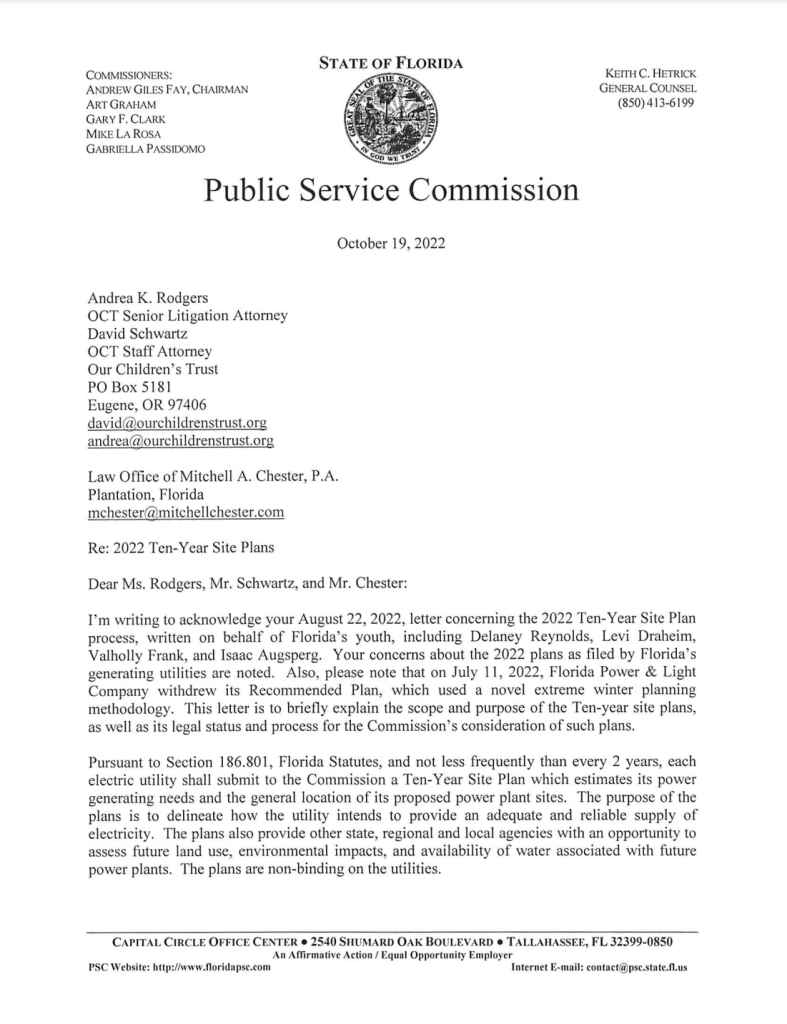
Late last month the PSC’s responded and I want to share their letter with you. Keeping in mind that our energy transformation away from fossil fuels is an essential key to solving our climate crisis it’s terribly important to understand that our society can’t solely rely on the very industries that have been causing and perpetuating the pollution for a century (utilities, auto makers, fossil fuel firms and other such stakeholders) to evolve into our renewable energy future on their own. Governments around the world, including yes right here in Florida, must provide the serious motivation, regulation, and rules for them to achieve what society and our climate deserve.

Unfortunately, the PSC’s initial response does not seem to fully grasp the gravity of our climate crisis, nor its own regulatory role in fixing the problem. Instead, the PSC sees itself as having an “informal” role, believes that its review of the Ten-Year Site Plans by utilities is but an “informal action” and that it’s not up to them to determine whether such a plan is “suitable” or “unsuitable” despite their role as Florida’s utility regulator. Here’s what they wrote my colleague and lawyer from the firm I am working with on this issue, Our Children’s Trust, Andrea Rodgers, in response to our August letter:

PSC page 1

PSC page 2

To be clear, the PSC’s initial response does not fully surprise me. The PSC has long been seen as a perhaps too friendly advocate for the utility industry so the idea that they would easily focus on the public’s concern and our new rule and something so important as the crisis we face should not surprise anyone. But, just like our energy providers, our governments must also evolve their thinking if we are ever going to truly evolve from today’s antiquated approach to power to one based on renewable energy. And, here in Florida, that certainly includes the Public Service Commission.

As I have said many times before, we’ve only just begun the hard work related to our new rule and the energy evolution that’s required to save special places all over Florida. The attached PSC response helps make that point and illustrates the types of challenges we will face not only from the utilities themselves, but government officials charged with regulating our energy providers. The good news is that I know I speak for young people all over our State of Florida and the world beyond when I say that we look forward to working to transition regulatory thought at places like the PSC, along with our energy system, before it’s too late.

1 … 16 17 18 19 20 … 38