“The United States has spent billions on a climate change initiative and ideology that is unfitting for our country without significant results. Our country would not be where it is today without fossil fuels.”
Florida Representative & HB 1645 Sponsor Bobby Payne, R- Palatka
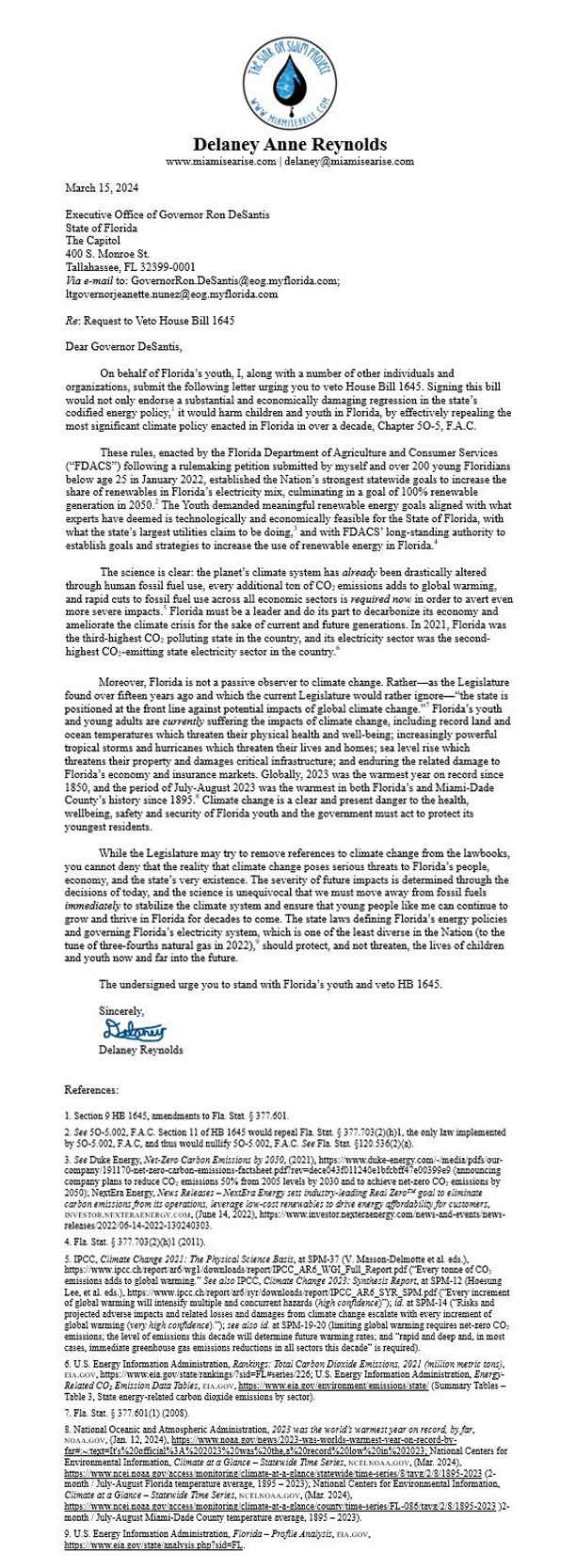
Investigative journalists all over Florida today have been reporting that Florida Governor Ron DeSantis’ office was directly involved in authoring provisions of Florida’s apparently soon to be new ULTRA UTILITY INDUSTRY FRIENDLY energy legislation, House Bill 1645. This horrific pending law awaits the Governor’s signature but if enacted it would do far more to take Florida’s energy policy back into the fossil fueled dark ages than just limit wind power as the article’s headline (“DeSantis’ office quietly backed ban on wind energy in Florida — onshore or off”) below announces. Some of the bill’s changes include:
- Removing legislative wording from current laws related to global climate change to, I guess, act as if the climate is not changing and sea level rise is not threating our state;
- Eliminating any mention of energy policy goals related to sustainable energy or global climate change;
- Making “resiliency facilities” to store and distribute all kinds of gas a permitted land use in every county and municipality in Florida permissible;
- Discouraging the state and local governments from purchasing electric vehicles;
- Reducing public and local government input on and review of gas pipeline projects under 100 miles in length;
- Eliminating the few clean renewable energy grant programs Florida has while providing utilities the ability to recover their costs related to the gas industry;
- And, yes, it prohibits wind energy within a mile of the coast as well as offshore.
Candidly, the bill is an embarrassment to the State of Florida. It so overtly panders to Florida’s electric utilities at the expense of the State’s consumers and our environment that we should question the very fitness to hold office of anyone who sponsored it, helped author it, or voted for it. Scientifically, Florida is well known to be ground zero for America’s climate crisis, especially sea level rise. Seas are rising. Temperatures are rising. Local governments all over the state are desperately planning for how much (or little) of their communities they can save in the decades to come and I can only wonder how humiliated they must be to learn that the state government and governor are supporting the electric utilities powered by fossil fuels over taxpayers or saving as much of Florida as possible. The pending law is, simply stated, a disgrace and anyone attached to it should be ashamed to do this to our environment and Florida’s future generations.
So why would your elected officials do this? Well, it’s certainly to help the utility industry. The next time you see or hear a Florida utility touting how much they “love” renewable energy such as solar or wind power, please consider the most recent statistics about where these often large, profitable businesses actually source their power. Here in Florida the amount of renewable energy our power companies currently source to fill Florida’s energy needs is shockingly small. Here are the facts according to their own financial reports and government publications:
1. As of 2022, 93% of Florida’s power is from non-renewable energy.
2. 81% of the energy Florida utilities source is from fossil fuels including coal, petroleum, and natural gas.
3. Natural gas, a methane emitting fossil fuel that is 28 times more damaging than carbon dioxide, accounts for 75% of the energy Florida utilities source.
4. And, while I am sharing numbers, consider that solar power, in a place called “The Sunshine State,” accounts for a pathetic 6% of all of the power Florida utilities source.
Now consider this: the State’s three largest utilities, all for-profit, investor-owned, gigantic businesses (FP&L, Duke Energy, and TECO) respectively sourced the following amount of their power last year from sustainable, renewable energy such as wind, solar, and hydro:
1. FP&L was 5%,
2. Duke was 1.5% including both solar and hydro,
3. TECO was 7%.
Collectively these three investor-owned utilities account for 75% of the power sold in Florida and each firm has been in business for at or over 100 years. So, I ask you, if left to their own devices do we have any reason to truly believe these businesses will stop using the very fossil fuels that are causing our planet to warm, glaciers to melt, and seas to rise? Of course not. Not in any meaningful way or soon enough to help solve our global climate crisis. That’s why Florida has had climate-oriented energy policies in place since the early 2000’s or, for that matter, supported the petition that implemented Rule 50-5: Renewable Energy, which I helped lead in 2022 and that sure seems to have scared the utilities into the action that led to HB 1645.
What HB 1645 does is allow Florida’s utilities to continue the pollution without the rules, laws, or regulatory accountability needed to transition our state’s energy system from one based on fossil fuels to one based on sustainable energy. Like I said, anyone who supported it in any manner should be ashamed of how overtly they have sold our state (and I suppose themselves) to the utility industry.
As the article below from today’s Tampa Bay Times reports, DeSantis’ office touted the energy bill in a recent news release related to what they called “victories” from the recent legislative session under a section entitled “Stop the Woke” in which they expressed how pleased they were with themselves. I can only imagine how pleased the electric and gas utilities must be to know that our state government has, once again, picked them over taxpaying citizens and our fragile environment.
DeSantis’ office quietly backed ban on wind energy in Florida — onshore or off
Gov. Ron DeSantis’ office quietly helped write a bill to curtail wind energy in the state of Florida, email records provided to the Tampa Bay Times show.
A version of that bill is now awaiting DeSantis’ signature to become law, which will ban offshore wind turbines in state waters. It also proposes to delete the majority of references to climate change found in state law, the Times previously reported.
Florida lawmakers passed the bills, Senate Bill 1624 and House Bill 1645, in early March, even though the state has no operational wind farms because Florida generally has slower wind speeds. Still, the ban on offshore turbines in state waters puzzled and frustrated opponents, who pointed to the fact that wind energy technology is rapidly improving and offshore wind energy could become more feasible in the near future. The bills’ sponsors, including Sen. Jay Collins, R-Tampa, said if that happens, they’d repeal the ban.
While debate over the bill continued in the halls of the Legislature, DeSantis’ office weighed in via email. Cody Farrill, a deputy chief of staff in the governor’s office, sent wording related to the wind ban multiple times to Collins and his staff in late January and early February. Some of the emails include Rep. Thad Altman, R-Indialantic, who, along with Collins in the Senate, sponsored a standalone ban on wind energy. That bill received no hearings, which by February meant it was in danger of dying.
“As discussed with Rep. Altman and Senator Collins, this is the preferred alternative for” the bills banning wind energy, wrote Farrill in one email addressed to the two lawmakers. It included an attachment with proposed bill language that would prohibit “the construction, operation, or expansion of a wind energy facility or an offshore wind energy facility in this state.”
That ban on all wind energy in the state is more expansive than the offshore-specific language eventually passed by lawmakers. In mid-February, similar language curbing wind energy was tacked on to a larger energy omnibus bill that had momentum in the Legislature, and was eventually passed by lawmakers.
The emails were first reported by independent journalist Jason Garcia of the Seeking Rents newsletter. They were provided to the Tampa Bay Times by the Energy and Policy Institute, a utilities watchdog group, which obtained them through a public records request.
The governor’s office did not respond to emails asking about his staff’s involvement and why the governor was interested in banning wind energy. Collins and Altman did not respond to voicemails seeking comment. Neither did Rep. Bobby Payne, R-Palatka, who sponsored the House version of the energy omnibus bill.
It’s unclear whether the governor’s office authored the original language that appeared in the first version of the wind energy ban, filed in early January. The first email included in the records request showing Farrill suggesting language tweaks was from Jan. 30.
In some of the suggestions, the governor’s office focused on banning wind energy facilities near “critical infrastructure.” At one point, a draft borrowed language froma separate law that limits land purchases by residents of certain foreign adversaries — including China, Russia, Iran, North Korea and Venezuela — near similar infrastructure.
“The close involvement of the governor’s office in the wind energy ban really seems to indicate that this is another DeSantis culture war in an attempt to win political points as opposed to addressing any serious issues that Floridians are actually concerned about,” said Alissa Jean Schafer, a research and communications manager at the Energy and Policy Institute. She said that the attempts to ban wind turbines near critical infrastructure could “lay a foundation for anti-renewables fear mongering.”
During the legislative session, rumors spread that DeSantis was backing the offshore wind ban. A Times/Herald reporter in late February asked Florida House Speaker Paul Renner whether it was something the governor wanted.
“I don’t know who wanted it,” Renner said at the time, adding that the prohibition made sense for the state. “It’s very similar to offshore drilling: Floridians don’t want to sit on the beach and look at oil derricks and they don’t want to sit on the beach and look at big windmills right off the beach.”
DeSantis’ office referenced the energy bill in a news release touting victories from the legislative session, under the section title of “Stopping the Woke.” The changes ensure “Florida’s energy policy focuses on the viability and availability of energy resources in the state, without subjecting the reliability of Florida’s grid to the pressures of the global Green New Deal regime,” his office wrote.
Other states, including Texas and those in the Midwest, have embraced wind as a clean source of energy. The power produced by the rotations of wind turbines helps the United States avoid 336 million metric tons of carbon dioxide emissions annually, according to the federal government, reducing the pollution that contributes to climate change.
A 2021 report from the nonpartisan Pew Research Center found that most Americans — 77% — support expanding wind energy. But pollsters found that a wedge was starting to form, as backing among Republicans and conservative independents had dropped 13 percentage points just since the previous year. It was the widest partisan gap since Pew started asking about wind power in 2016.
Times/Herald Tallahassee bureau reporter Lawrence Mower contributed to this report. This story was produced in partnership with the Florida Climate Reporting Network, a multi-newsroom initiative founded by the Miami Herald, the South Florida Sun Sentinel, The Palm Beach Post, the Orlando Sentinel, WLRN Public Media and the Tampa Bay Times. This story was originally published March 28, 2024, 4:27 PM. Read more at: https://www.miamiherald.com/news/local/environment/climate-change/article287178015.html#storylink=cpy